

Review: Pilobolus' 'Trips' is Exactly What Dance Needs Right Now
In 2026, Pilobolus' "rebellious dance" isn't merely countercultural subversion. It's a vital reimagination of what dance—and watching dance—is and can become.
Despite its stature, Pilobolus is not a self-serious dance company. Its name alone invites comical mispronunciations, and discovering what pilobolus means (a fungus that grows on cow dung) made me grin idiotically.
Since its founding in 1973 by a group of Dartmouth undergraduates, the company has prided itself on creating “rebellious dance,” or, put another way, making dance fun again. Yet as audiences grow grey-haired and certain stars dismiss centuries-old art forms as things “no one cares about,” Pilobolus’ mission feels less like counter-cultural subversion and more like a necessary reimagination of what dance—and watching dance—is and can become.
The company’s 2026 showcase at the Joyce, glibly titled Trips, is an extended imaginative exercise. Before the curtain rises, two “flight attendants” mime a safety briefing and encourage us not merely to silence but to power off our phones: “You can do it,” they coo. Didn’t you come here for a break from the real world, anyway? The program doubles as an aircraft safety card; the intermission becomes a layover. We the audience are transformed from passive spectators into fellow voyagers.
When Bloodlines (2024) begins, it's clear we’ve entered zero-gravity. Wrapped in a chest-to-chest embrace, Hannah Klinkman and Anouk Otesa orbit in a circle. Alternately, they levitate, buoyed not by force but by shared momentum. In modern dance, partners typically bear one another’s weight and pull each other through space. Here, the line between supporter and supported, follower and leader, fades into irrelevance. They are less a duo than a body split in two—like the lovers in Plato’s Symposium, they cartwheel and crawl with four legs, four arms, and one soul.
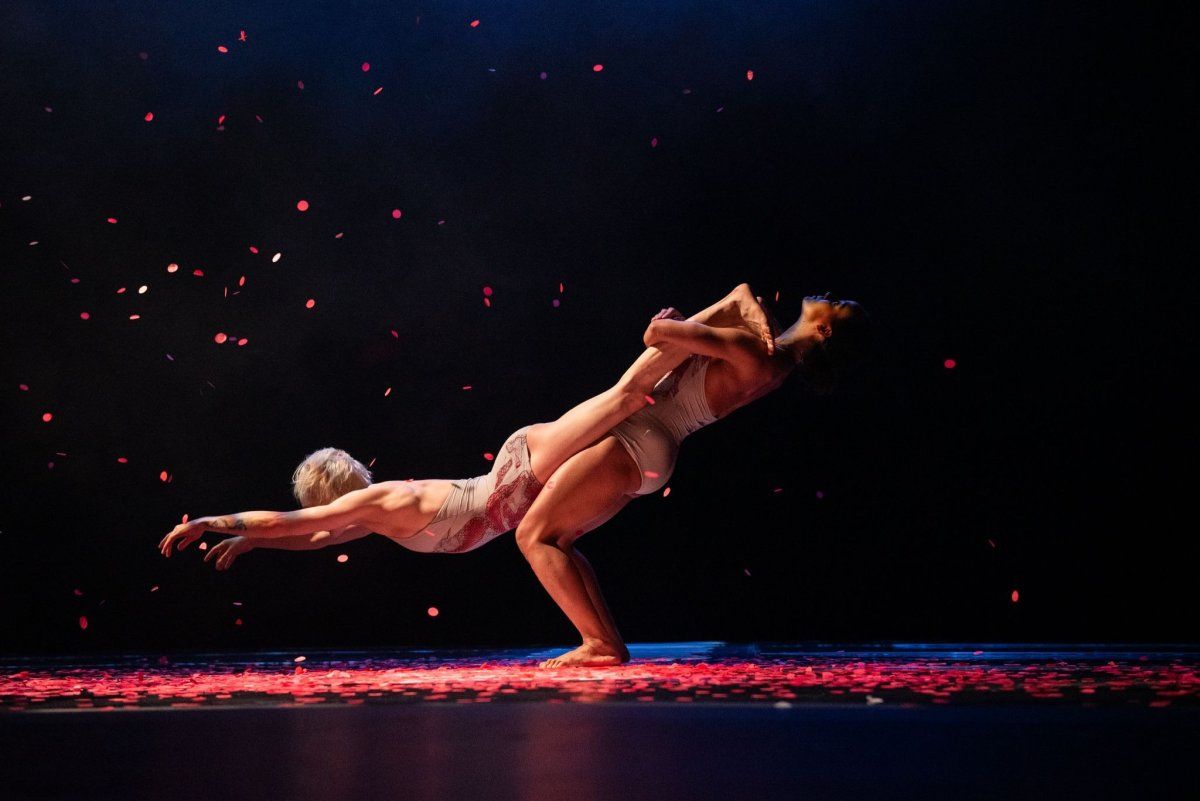
Yet as the dance unfolds, the two enter a cycle of shifting dependencies: Otesa lies supine while Klinkman watches over her; later, Otesa cradles Klinkman in a quasi-Pietà. They become every duo at once—mother and child, friends and lovers. Red confetti fluttering to the ground reads simultaneously as romantic rose petals and red blood cells. Bloodlines doesn’t trace the contours of any single kind of relationship; it reckons with what it means to be profoundly connected to another person while remaining fundamentally, painfully separate.
A “janitor” (the winsome Connor Chaparro) sweeps the stage and brings us back to earth. He’s only capable of repeating the same phrase in different tones: “Excuse me!” he yells at an “audience member” (Isaac Huerta) shining his phone’s flashlight. “Excuse me!” he declares as the two square up to fight, stripping off their clothes. When they turn around to see they’re both wearing identical yellow bodysuits, they chest bump, and Walklyndon (1971) begins.
This transition could’ve fallen flat as a facile gimmick, but this is what distinguishes Pilobolus. Like a child playing pretend (“and then, and then!”), they push the joke three steps further, and the result is as absurd as it is satisfying.
Walklyndon, choreographed by the company’s founders, is the quintessential example. The musicless “dance” has a straightforward premise: a quintet of performers take turns walking across the stage. They run into each other; they run away from each other. They leap into each other’s arms and vault over each other’s heads. The dance juxtaposes acrobatic stunts (crossing the stage in a handstand) with everyday instances of miscommunication (a high-five or handshake mix-up). It reframes dance—often conceived of as technical or virtuosic, and exclusive to skilled performers—to span the full spectrum of human movement, including walking, flipping, and stumbling.
Like a string of comic sketches, each pass grows more elaborate and improbable. It’s this willingness to push a simple idea to its most ridiculous limits that keeps half-century-old slapstick fresh. In the silence, I’m especially attuned to the audience’s regular bursts of laughter, the piece’s unofficial soundtrack.
Given all of Walklyndon and Bloodlines’ lifting and flipping, it’s clear that Pilobolus is interested in transcending the human body’s limitations. Yet Flight (2024) suggests that this transcendence might depend less on bodily strength than on imagination.
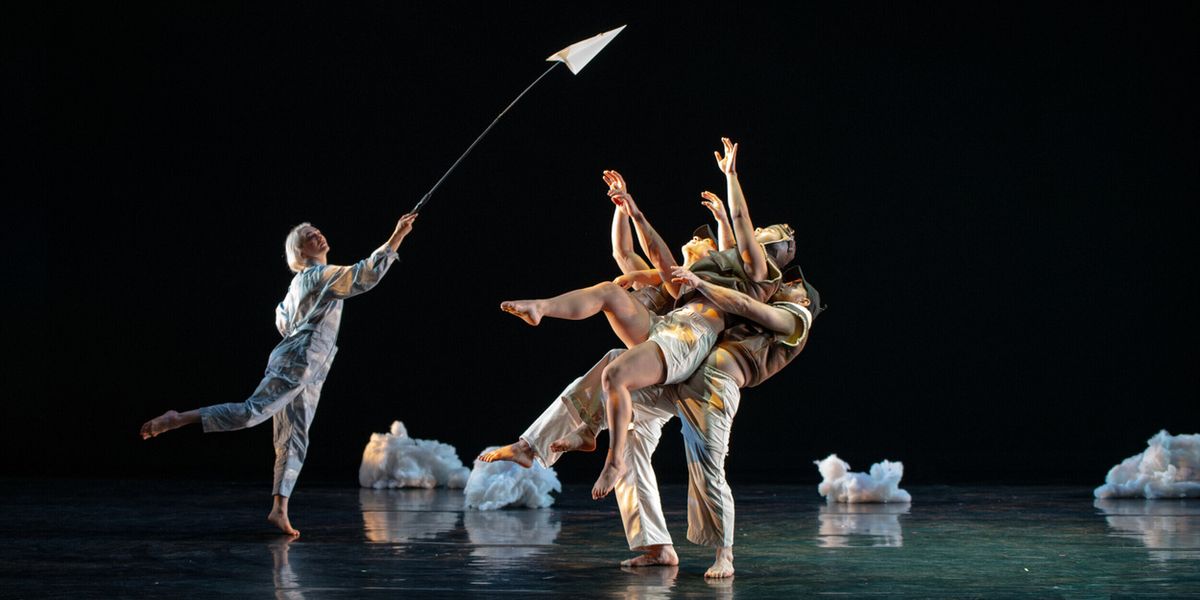
Choreographed with Lee Harris, a Pilobolus co-founder and pilot, Flight follows a trio’s (Otesa, Chaparro, and Huerta) fascination with all things airborne. The dance evokes a child’s idea of flying, complete with cotton clouds and corny leather pilot vests. The dancers chase a paper airplane—mimicking its swirling flight patterns, studying its aerodynamics—before earning their own planes and triumphantly sending them aloft. The effect is playful, but their curiosity is not being mocked; it's what propels their next discovery.
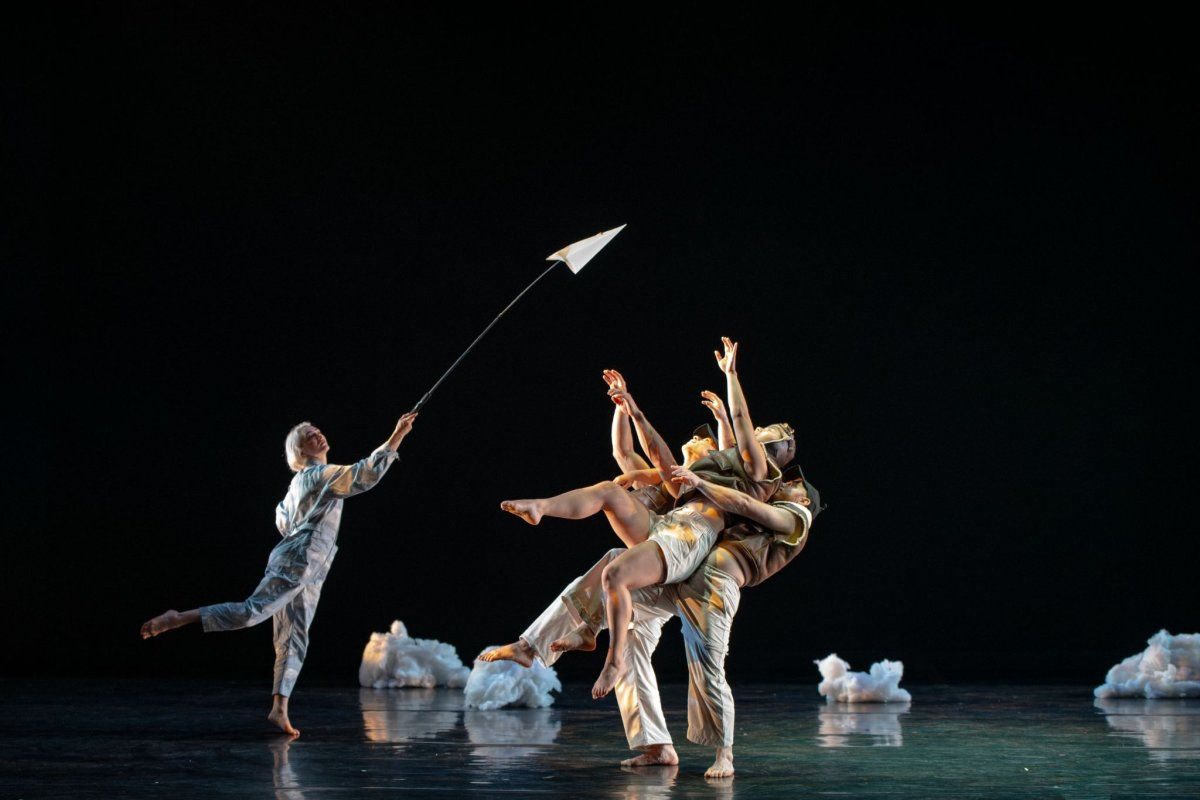
With the same relentless curiosity, they trade their airplanes for a ten-foot pole. It becomes a roller coaster, a vaulting rod, and eventually, an ersatz plane. As Otesa floats across the stage, it’s clear the trio’s athleticism isn’t what makes the moment feel like flight. Rather, it’s their earnest belief in its possibility.
This blend of humor and sincerity is what makes Pilobolus so appealing right now. It’s not just funny dance; it’s dance that uses humor to imagine alternative realities, to widen our sense of what’s possible.
Take Klinkman’s fluid yet dynamic performance of Pseudopodia (1973), a classic Pilobolus solo. As Klinkman tumbles and twists across the stage, rarely rising to standing, I find myself imagining the human body less as a rigid structure than as a shapeshifting organism, continually adapting to new patterns of motion.
Particle Zoo (1990) similarly traces the erratic motion of an oft-overlooked organism: the subatomic particle. A quartet of shirtless men zig and zag, bouncing off each other with dizzying speed and astonishing force. Like subatomic particles, they seem to exist simultaneously as solid objects and what quantum physicists call “a cloud of possibility.” And like a buzzing swarm of particles, they explore every form of motion—expansion, contraction, collision, repulsion—and every form of interaction—walking on each other’s hands and, at one point, spinning on each another’s shoulders.
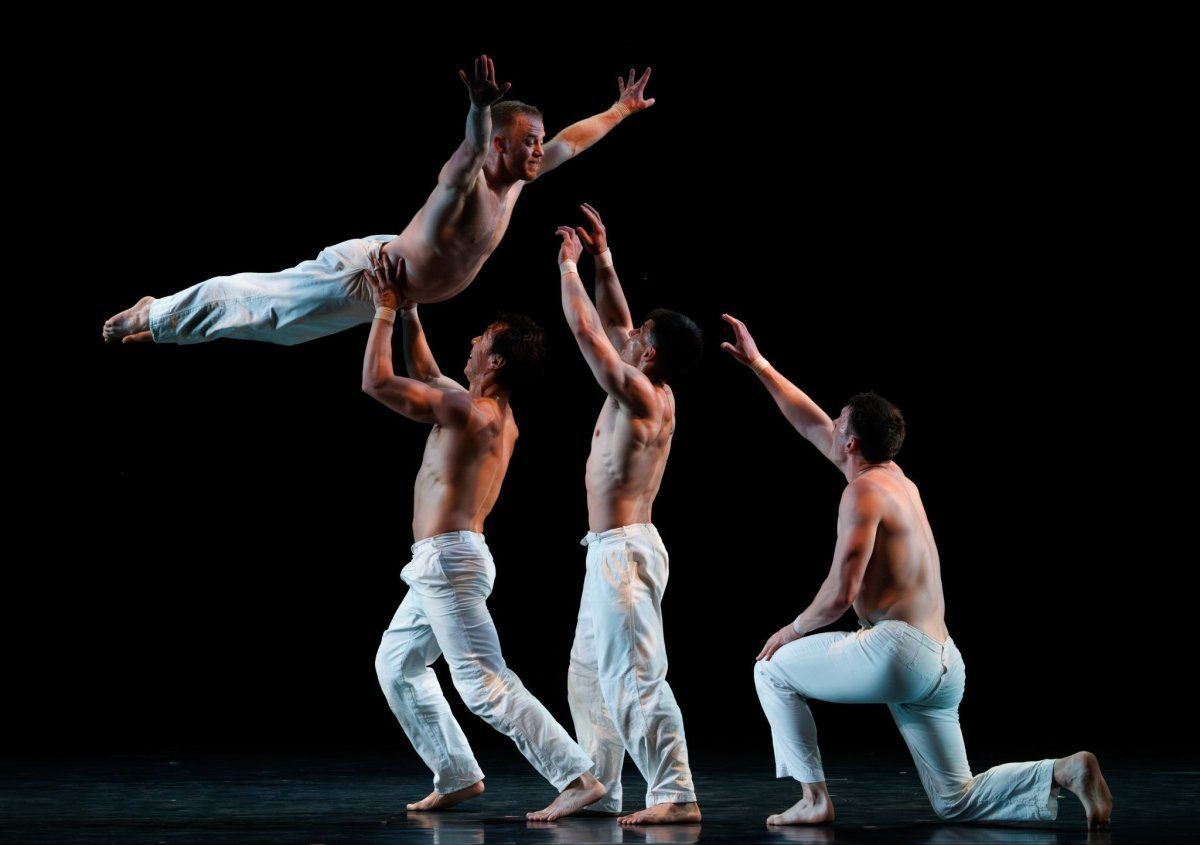
Their endless search for a place within the atom doubles as a metaphor for masculinity and belonging. Perhaps it’s their shirtlessness, but all their relays and lifts begin to read as shows of masculine bravado and attempts to outdo one another’s strength. One dancer tries to earn his place in the group by matching their athleticism, but it’s only when their frenetic energy slows to a homosocial simmer that he’s absorbed into their collective. Clasping each other’s necks and pressing foreheads, the dance imagines a quieter, more internal form of masculinity.
I’m usually ready for even the most impressive dance performances to wrap up—my attention falters, my energy dwindles. But when the curtain closes, I linger in my seat, not quite ready for this trip to end.
To post a comment, you must register and login.