


Review: Mark Morris Still Has Stories to Tell
In "Dances to American Music" at the Joyce Theatre, Morris pays tribute to regional American music. His country-western program centers on songs that tell stories.
Mark Morris’s “Deck of Cards”—a 1983 work that hasn’t been performed since 2000— consists of three solos. The first is performed by a toy semi-truck. Headlights blazing, the rig spins and veers to the rhythms of Jimmy Logsdon’s rockabilly “Gear Jammer.” It’s a charming if risky move: once the shocked laughter subsides, we’re stuck watching a toy truck circle the stage for three minutes.
In a performance ecosystem saturated with short dances jam-packed with movement, Morris stops us in our tracks. He redirects our attention to the music and the story—in this case, that of a semi-truck driver whose love of blondes gets him robbed. What often registers as secondary occupies center stage, and this shift primes us for every dance that follows.
This is nothing new for Morris, whose name is rarely invoked without reference to his musicality. “Dances to American Music,” a series of three programs the company is presenting at the Joyce this month, pays homage to the dancemaker’s lifelong engagement with American musical traditions. What distinguishes “Deck of Cards” and the other dances on the country and western music program, however, is their investment in storytelling.
Take the second solo in “Deck of Cards”: Billy Smith waltzes across the stage in a pink dress and heels, pinwheeling and pirouetting to George Jones’ “Say It’s Not You,” a ballad in which a man begs his lover to disavow rumors that she’s been unfaithful. It’s tempting to cast Smith as the betrayer made flesh, to believe we’re getting her perspective, but Morris isn’t interested in such easy subversions. Even as Smith skillfully embodies the loose-limbed fluidity of the faithless woman, he telegraphs the angst of the scorned man—assuming a defensive posture when Jones sings that “each night she leaves with someone new.”
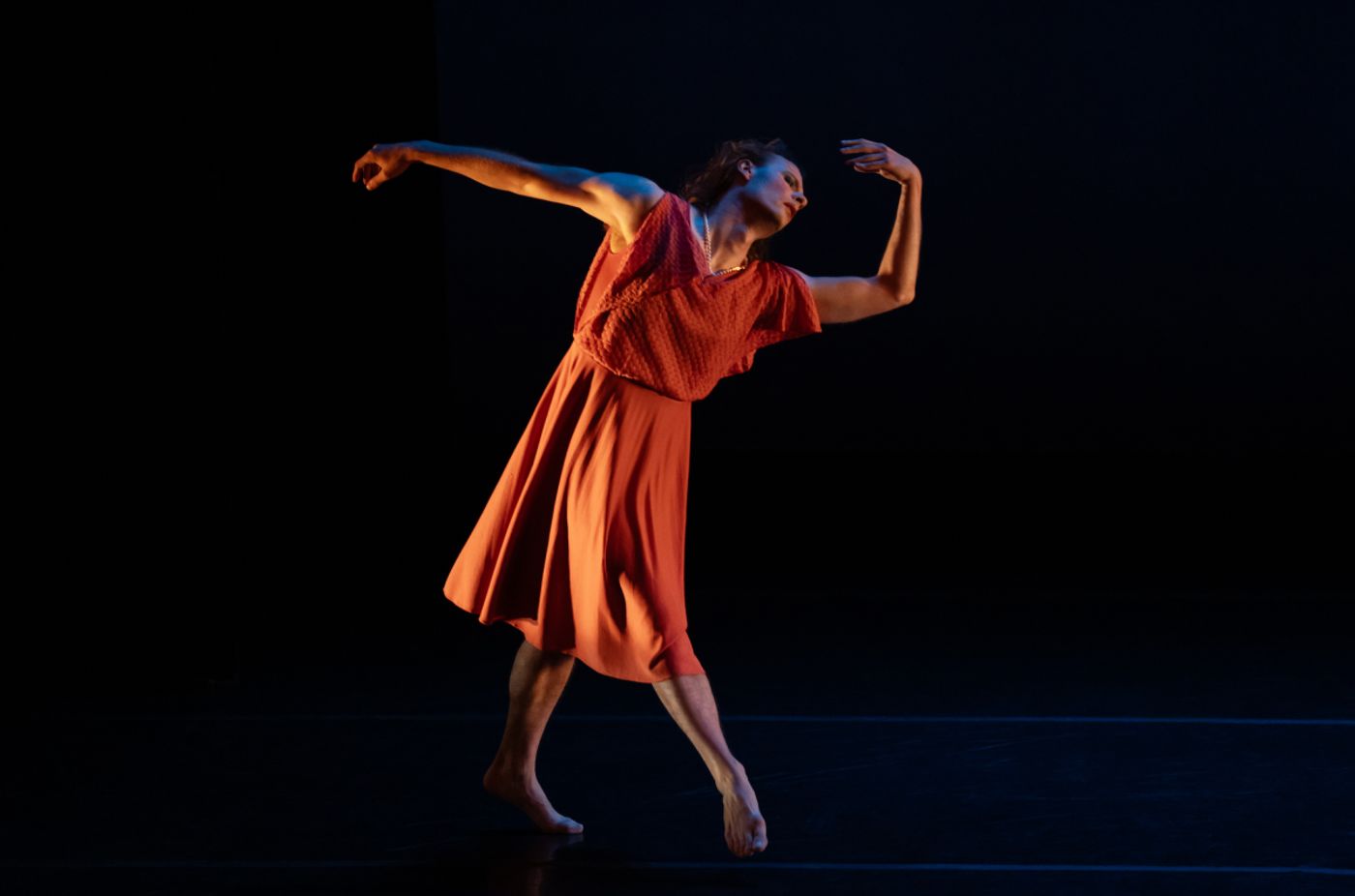
This layering of shabby drag and deep pathos is funny, but the dance isn’t a joke. Morris makes gender a visible performance, exposing its constructedness even as he calls attention to the way it shapes how a body moves and feels. Just as the man and his lover share the same body, Smith’s movement inevitably recalls Morris himself, the only other dancer to perform the role. In this collision of dancer and dancemaker, man and woman, the speaker’s grief transforms from something personal and private to something free-floating and shared.
Completing the triptych is a soldier (the winsome Dallas McMurray) who wryly insists playing cards can be a form of Christian devotion. Echoing the accumulation of selves in the last dance, Morris adds a new gesture with each card, and with each new gesture, the entire sequence repeats. As the movement accelerates and gestures accumulate, McMurray’s angular, expressive movement begins to resemble vogueing—a style of dance that originated in the drag ballroom scene. The masculine soldier becomes a flamboyant performer; his miming of religious symbols becomes queer self-expression.
All of this vogueing and drag is set to country-western music—a genre often dismissed as conservative and exclusive. Morris’s logic is not one of opposition but of accumulation: by layering queer aesthetics onto country music, he expands our sense of what the genre can hold.
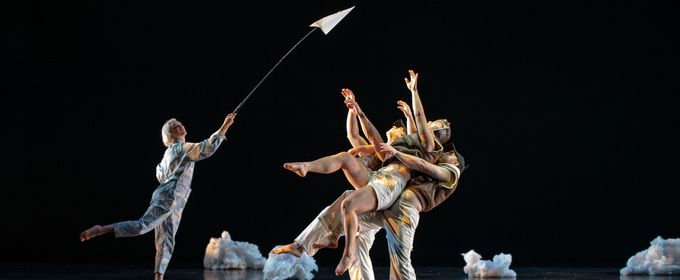
Another one of Morris’s early works, “Songs that Tell a Story” (1982), takes a more distant approach. Rather than embodying the songs’ characters, three bards decked in denim mime the events in canon, as if mimicking the ways stories are passed down. These Louvin Brothers tracks are mostly about how giving “your heart and soul to Jesus” eases suffering—be it a son’s death or the threat of nuclear annihilation.
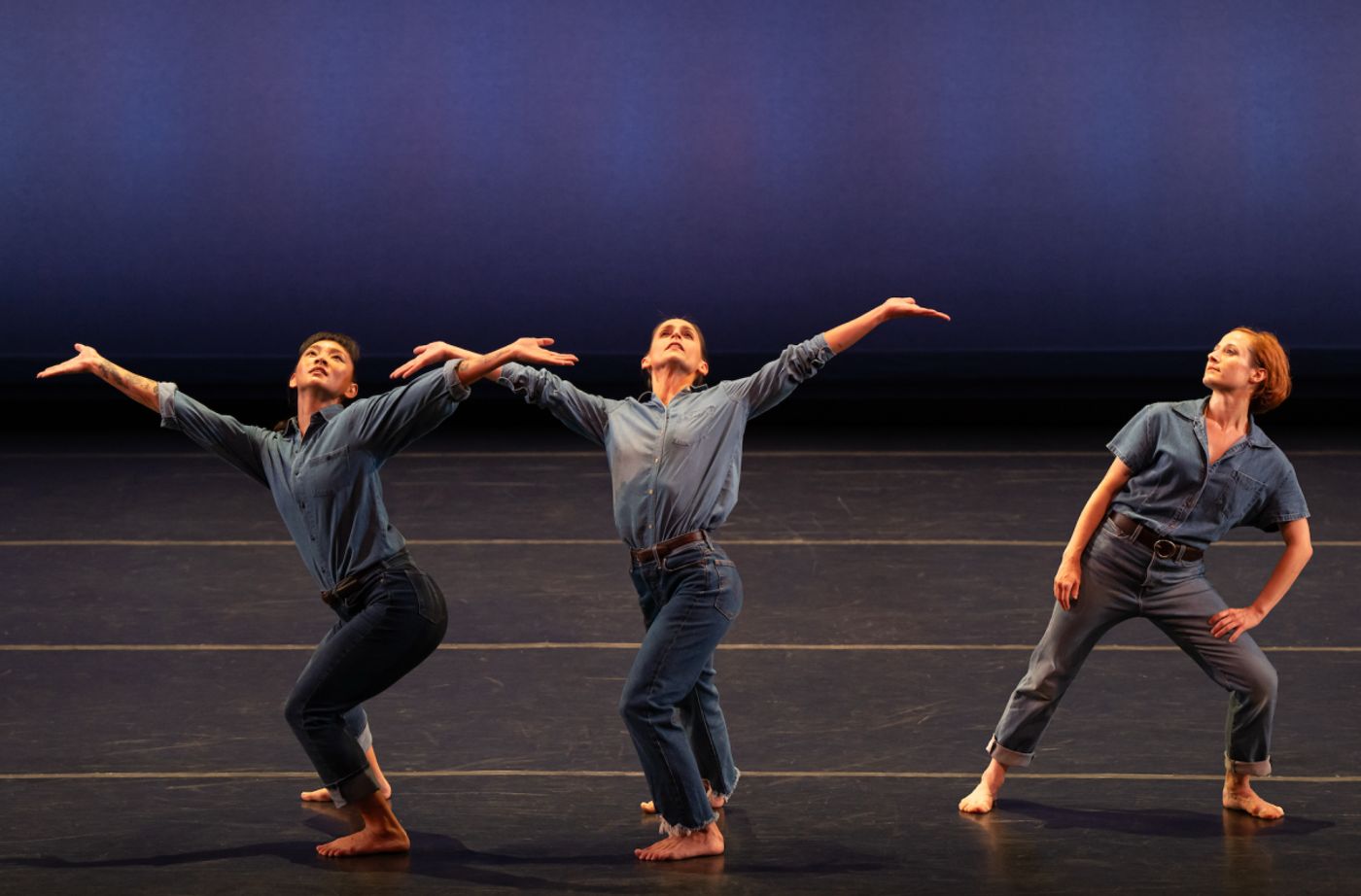
The dancers are both grounded and weightless, skimming the air before collapsing to the floor, echoing the songs’ blend of hopefulness and despair. Their cyclical movement simultaneously complicates the Brothers’ promise that faith absolves suffering, instead reframing religion as a repetitive practice, not a one-time antidote.
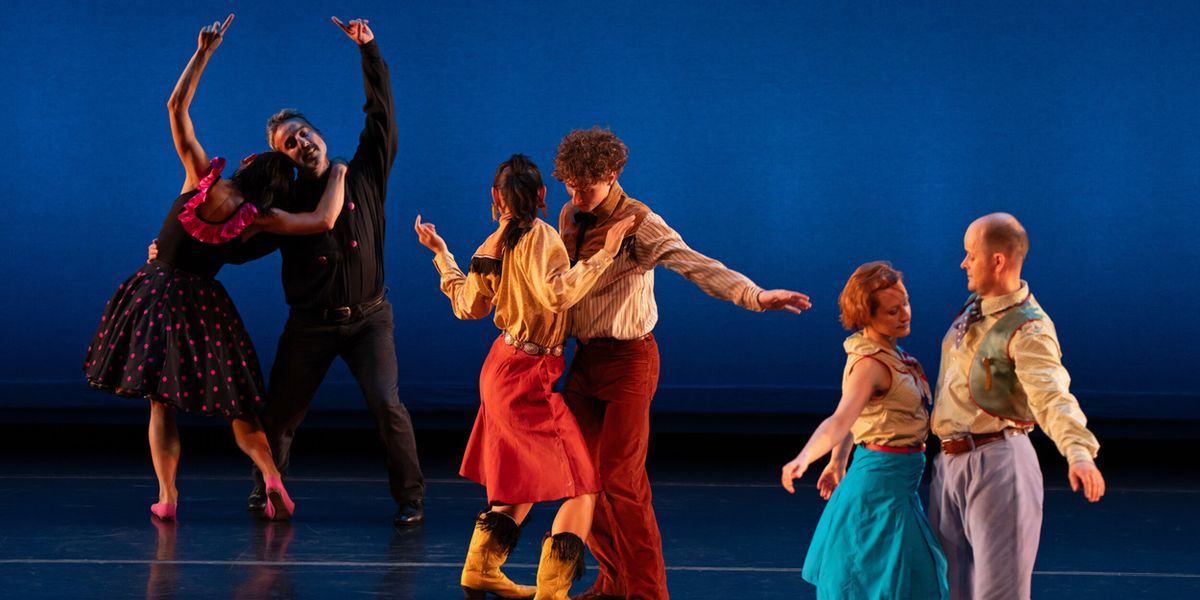
Interspersed throughout the first act are excerpts from “Home” (1993), a breezy clogging number whose formations and synchronized movement call to mind square dancing and, maybe just because it’s country-western night, barn parties. It previews the asymmetrical, 7-person square dance in Morris’s “Going Away Party” (1990), whose bawdy, exaggerated depiction of straight relationships has made it a fan favorite.
There’s no formal drag here, yet at the same time, everyone is in drag. Gendered motifs permeate: women apply lipstick; men turn their backs to take a piss. The couples perform gender dynamics—ogling, chasing, and dragging each other—that feel familiar in real life but foreign on stage. At various points in the piece, the men hoist their female partners onto their shoulders, their legs spread wide, ankles rolling. Much like in square dancing’s defined gendered roles—traditionally, men lead and women follow—Morris frames masculinity and femininity as oppositionally constructed. There can’t be a leader without a follower, and there can’t be a man without a woman.
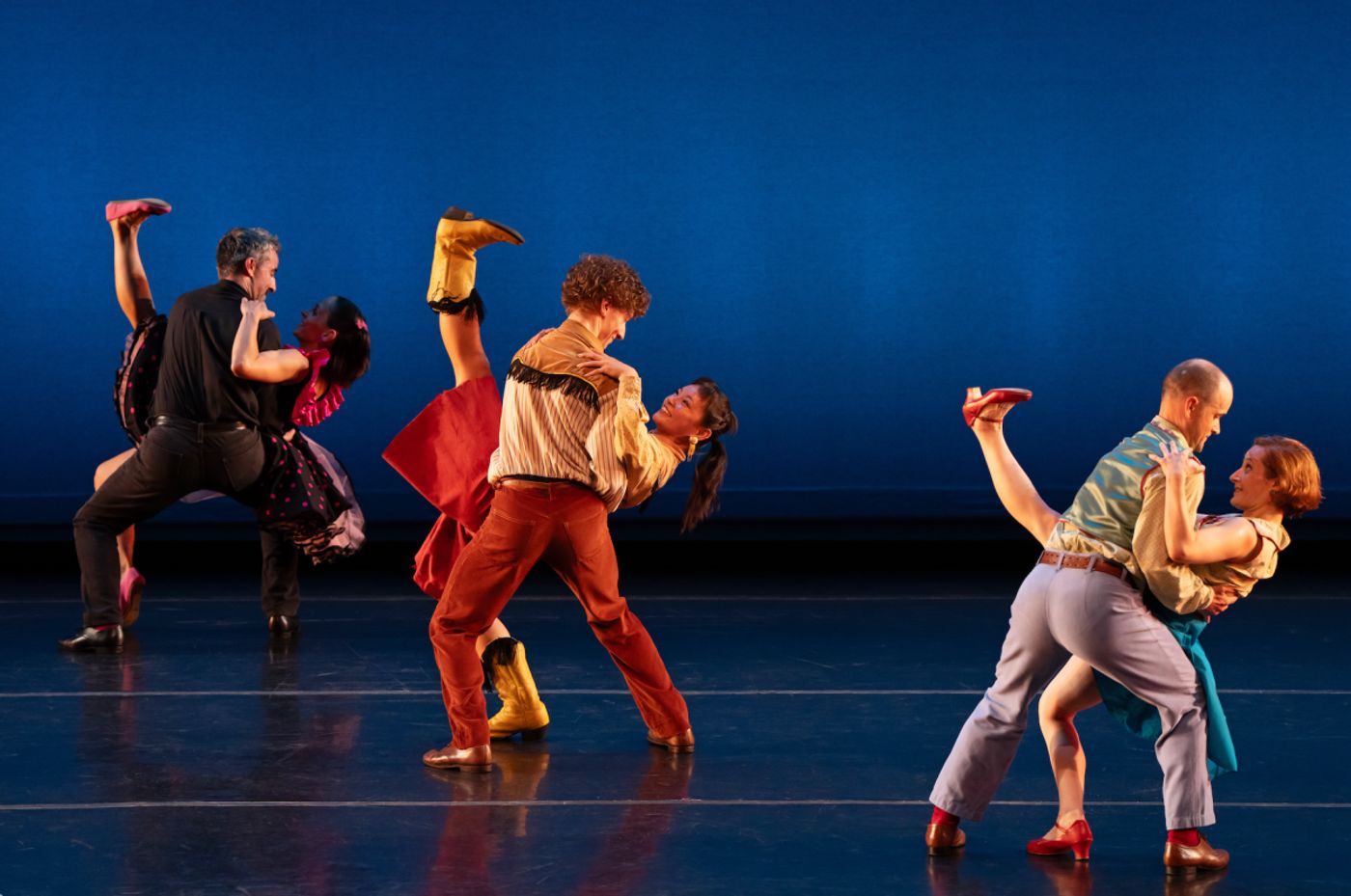
Save a flip, the movement is straightforward, not unlike ordinary people dancing at a barn party. When there are pirouettes, they are mostly singles, and when the dancers kick their legs, their feet don’t reach their ears.
This isn’t because Morris’s performers lack the technical ability to deliver all of contemporary dance’s bells and whistles, but because the choreographer is less interested in virtuosity for its own sake than in the layered relationships happening on stage: between dancers, between story and storyteller, between music and movement.
Morris’s real skill is in mining familiar gestures to craft something new and precise. The Dance Group’s motto, after all, is that “dance is for everybody.” That doesn’t mean every person can perform every dance, but that every body carries stories worth dancing. “Dances to American Music” tells them with equal parts compassion, humor, and sincerity.
The Joyce Theatre is located at 175 8th Avenue, New York, New York 10011. For tickets to Mark Morris Dance Group's "Dances to American Music" and other upcoming performances, please visit The Joyce l Performances.
Reader Reviews
To post a comment, you must register and login.