


Review: COPENHAGEN, Hampstead Theatre
Michael Frayn's award-laden imagining of a mysterious scientific conversations earns a timely revival
 It is not difficult to grasp the animating spark of a fission bomb, the one that flattened Hiroshima. Diana Ross even recorded a song about it! And, since the late 90s when Michael Frayn’s avowedly not dumbed down play baffled some and wowed others, the public has handed over nearly a $1B to see Oppenheimer, Christopher Nolan’s epic account of The Manhattan Project. Most of us know a bit more now than we did then.
But, reading David C Cassidy’s definitive Uncertainty: Life and Science of Werner Heisenberg some 30 years ago, I was reminded of Caspar David Friedrich’s magnificent Wanderer Above A Sea Of Fog. The painting’s lone figure felt like a portrait of Heisenberg, a whole century before he would so often go into those mountains, alone, inscrutable (back towards us), a self-mythologising embodiment of German Romanticism staring into mist from on high, waiting for it to bend to his will and clear.
That it never quite did, not for his research into quantum mechanics, his (in)famous Uncertainty Principle insisting that there will always be fog, nor in his answer to the enquiry, “What did you do in The War Daddy?”, drives some of the many questions in this weighty drama.
Do you need to know any of the highly abstract science to enjoy the production? Not really, as Richard Feynman was right in saying that such ideas are so counterintuitive, so buried in opaque mathematics that nobody really knows much. You do need to know that, as the fact that you’re reading this as it whistles from one computer to another attests and as Heisenberg always insisted, quantum mechanics works.
Accepting that Schrödinger’s Cat can only be definitively alive or dead when we open the box isn’t even close to the theories’ craziest notions - let me introduce you to Quantum Entanglement. Well, maybe not now…
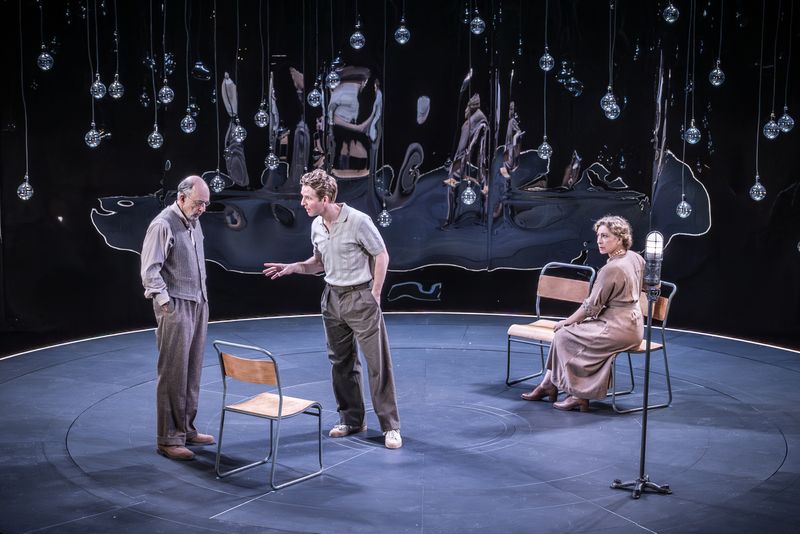
What we see on stage is the human tangled relationship between two brilliant men destined to be on opposite sides of the Nazi war machine but united by the mutual respect that comes of game seeing game. Heisenberg, in his early 20s, was Niels Bohr’s assistant in his sub-atomic theoretical physics research, key players in the development of Copenhagen Interpretation, an astonishing starburst of rigorous creative thinking compressed into three years in the mid-1920s.
Their relationship was intense, more father and son than sorcerer and apprentice (though there was a bit of that too) which magnified the distance that had grown between them by 1941, the half-Jewish Dane resenting the German’s equivocation in the face of the Nazification of Physics within the Reich.
Matters came to a head - well, maybe they did, nobody’s quite sure - when Heisenberg travelled to occupied Denmark to visit his erstwhile mentor and they squabbled over politics like ex-lovers squabble over the dog. Or did they really fall out over radioactive decay, an arcane subject suddenly freighted with much higher stakes? After all, there were rumours, more than that really, of nascent programmes, under both Allied and Axis Powers, to study fission with a view to its weaponisation?
Accounts are, err… uncertain, about what was actually discussed on those walks and the speculation that has grown up around those conversations is the engine of the drama. The narrative loops backwards and forwards in time, repeats with slightly different dialogue and, not unintentionally, makes a Cat of Heisenberg, both a live collaborator with Albert Speer’s Ministry of Armaments and a dead weight obstructing The Bomb while Oppie and co forged ahead in the New Mexico desert.
It’s terribly clever, the kind of chewy material that requires a decent night’s sleep beforehand, but it could be very dry, more the stuff of a contentious panel at a symposium, but Frayn’s dialogue and boldness in trusting his audience creates genuine tension and we sway between the men and the ideas, knowing now what they didn’t then.
Damien Molony gives the younger man a cocky self-assuredness, the golden child of the scientific revolution in which he stormed the barricades. But he’s torn, partly because he can see that the country he loves is being replaced by a fascist cult he does not and partly because he can see his father figure’s trauma.
It’s worth mentioning here that Heisenberg may or may not have dragged his heels over his work on the Nazi Bomb (current thinking is that he probably didn’t, though the play suggests otherwise) but he did not embrace his job with the zeal of Wernher von Braun, whose rockets left a crack in the wall of my flat. He went on to broker his knowledge (learned at the forced labour camp at Peenemünde), his good looks and aristocratic charisma to take a senior role in the American space programme and appear as an avuncular grandfather in films as its public face. I wonder if those who refused the hand of Heisenberg also shunned von Braun, whose role in the manufacture of weapons of mass destruction was never in doubt?
Back in the play, Richard Schiff catches Bohr’s paternalism (I was amazed to learn that he was only 16 years older than his protégé) and also his bitterness at the turn history has taken, driving a wedge between them. There’s a broken buddy movie inside the talk of electrons and E=MC^2 that often bubbles to the surface.
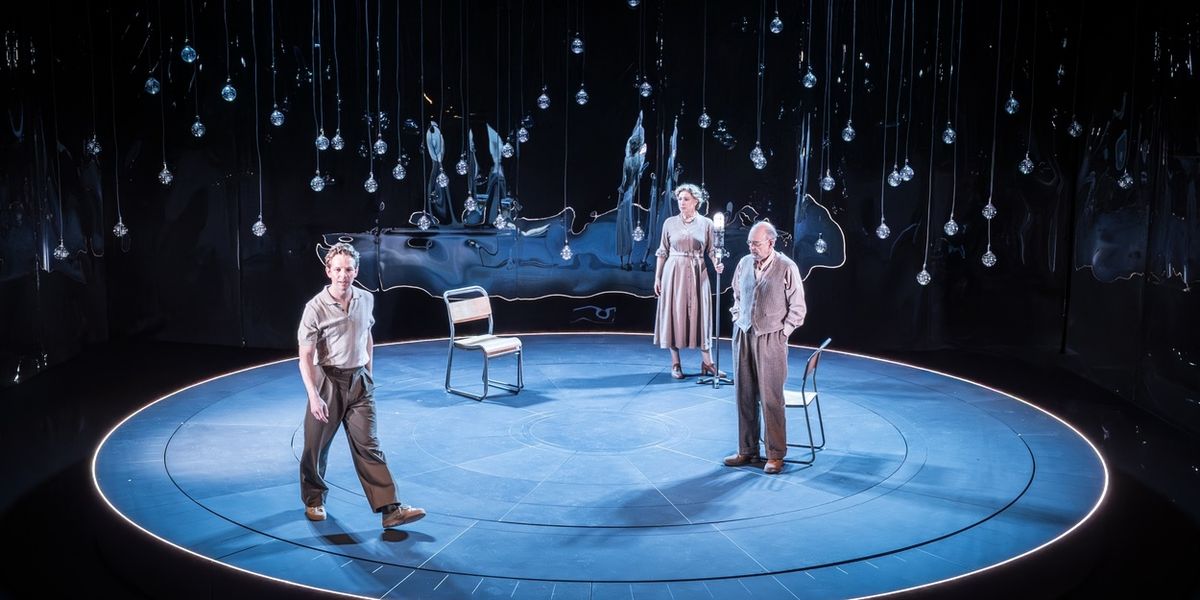
A crucial figure in the play, a centre of Joanna Scotcher’s spare set that rotates like Bohr’s orbital model of the atom, one largely swept away by quantum theory, is Alex Kingston’s Margrethe, Bohr’s wife. A working colleague of her husband, she dislikes, resents and distrusts Heisenberg swinging back into their lives, a vital counterpoint to the tech bros vibe between the two men. She is also our voice, prompting exposition which is never clunky, but does slow the pace for anyone who already knows the difference between U235 and U238.
As a US president drags his feet on defining a nuclear weapon as purely a deterrent and not a handy tactical option, Copenhagen’s revival is timely. It’s also a necessary balance to the successes of YouTube channels, which can explain and illustrate deep science with extraordinary clarity these days.
As ever, the ethics of what advances in quantum engineering means for us, then and now, is harder to bring to a general audience - quantum computers look at least as scary as AI over the next ten years. On such philosophical issues perhaps we can only ever limit our uncertainty. After all, the realm of moral certainty lies in the field of religion not science.
Copenhagen is at Hampstead Theatre until 2 May
Photo images: Marc Brenner
Sign up for all the news on the Fall season, discounts & more...
.jpg?format=auto&width=300)






Reader Reviews
To post a comment, you must register and login.