
Review: DON GIOVANNI a Bel Canto Opera? Crutchfield’s Teatro Nuovo Proves It
Another Unfamiliar Turn on a Well-Known Work Has Surprises, Both Good and Slightly Disappointing
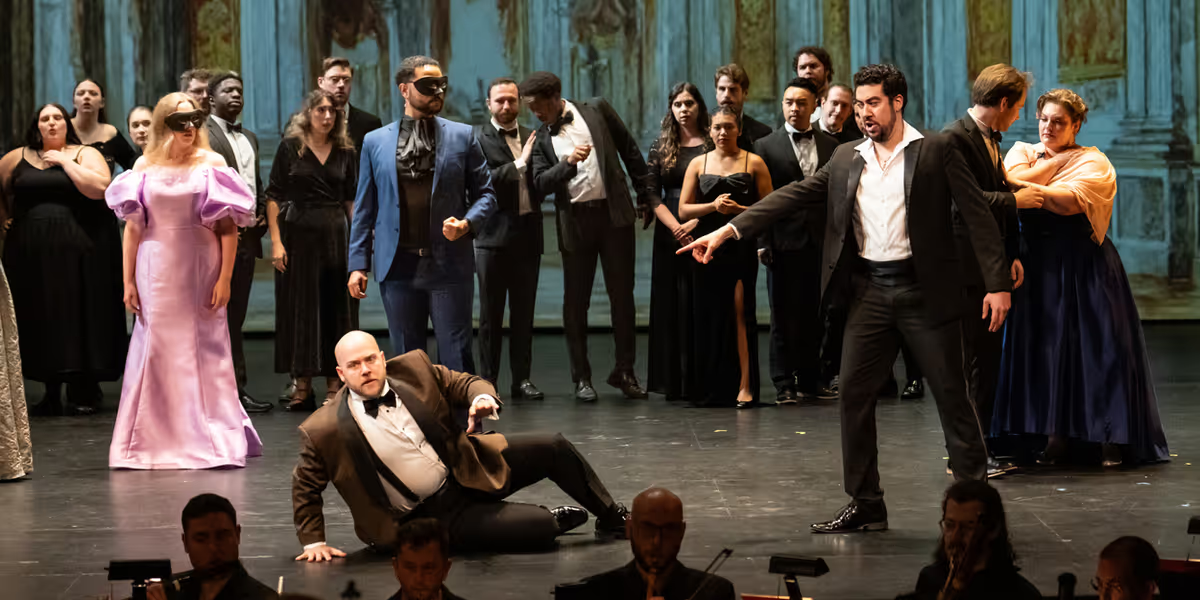
To “IL” or not to “IL”—that is the question. According to the program at the other night’s performance by Will Crutchfield’s Teatro Nuovo (TN) of Mozart’s great opera about Don Juan, it’s IL DON GIOVANNI, rather than simply the familiar DON GIOVANNI. That’s as it was called by its librettist (the composer’s great collaborator, Lorenzo da Ponte) and the portrayer of the eponymous anti-hero (baritone Manuel Garcia Sr.) on its first visit to New York 200 years ago, when Italian opera arrived here for the first time.
Here, at the Rose Theatre of Jazz from Lincoln Center, with the company in fine form, both vocally and orchestrally, the program explained that the “IL” was dropped along the way when the opera was performed as DON JUAN in French and German. Frankly, of all the changes that the company made to the score, the article before his name was the least significant.
Don’t get me wrong. I still love it and it’s still my favorite of Mozart’s operas…just, perhaps, a very little less so. Since TN specializes in all things bel canto, it was surprising and delightful to hear some favorite arias with unexpected ornamentation. (Bel canto style never met a trill or glissando it didn’t like.) Also, there was the execution of the portamento—with one note gliding into the next—with phrasing done in full voice.
On the other hand, working with versions of the score from Prague (where it premiered) and Vienna, there were some cuts and shuffling of placement of arias that were harder for me to accept—especially with the skilled cast of singers assembled for the occasion. (Less noticeable to me, at least, was editing in the orchestration for TN’s , though I found the overture pretty much as expected, under the skilled baton of Geoffrey Loff, who also handled the continuo in conjunction with cellist Hilary Metzger.)
It’s hard to call the title role the “star,” since although the action revolves around him, he doesn’t have the most (or most winning) music to sing, but baritone Ricardo Jose Rivera used his smooth instrument and fine acting skills to great advantage as the Don, whether in what’s usually called “the champagne aria” (“Fin ch'han dal vino”) or in duet with the village girl, Zerlina (unusually large-voiced mezzo Simona Genga), in “La ci darem la mano.” Rivera has previously shown himself an indispensible TN-ite, in an early version of Verdi’s MACBETH and the little-known ANNA DI RESBURGO by Carolina Uccelli.
Still, with some of Mozart’s most appealing melodies, the two main female roles, Donna Anna and Donna Elvira, are hard to compete with. As Anna, soprano Elizabeth Novella did a first-rate job with her wonderful showpieces, “Or sai che l’onore” and “Non mi dir,” though I wondered whether her completely full-voiced performances were due to personal characterization or the version in use. In any case, she impressed.
My favorite role is usually Elvira, and the cast had a wonderful one in mezzo Sedona Libero. Yet, this version played with my expectations—moving her “Mi tradi” from the second act to the first, following on from her “Ah! chi mi dice mai.” While it may have worked better dramatically, I have always like it in the trio of arias in Act II: next to Anna’s “Or sai…” and Don Ottavio’s “Il mio tesoro.” She did well with the change of Elvira’s persona—a little less gaga over the Don and the treatment she is given—and sounded just plain marvelous.
One of the reasons I sometimes find the opera disappointing in performance is because it’s so hard to cast all the first-rate singers it demands. There was none of that here. Bass-baritone Kevin Spooner was a sturdy Leporello, with a charming rendition of “The Catalogue Aria” (“Madamina! Il catalogo e questo…”), while tenor Martin Luther Clark delighted in Ottavio’s “Il mio tesoro” and made me miss the character’s “Dalla sua pace” (cut here) even more than I might have otherwise.
Bass-baritone Daniel Mobbs was a commanding Commendatore, Donna Anna’s murdered father, who finally gives the Don his comeuppance. Lastly, there was baritone Noah B. Rogers’s amiable Masetto; he lost his aria in the reconfiguration of this version and became more of a walk-on rather than a performance, which seemed unfortunate from what we saw.
The simple, but effective projections for the set are by Adam J. Thompson, based in part on period designs by Phillippe Chaperon and Simone Quaglio, with lighting by Stephen Smart.
All in all, this was an extremely enjoyable DON GIOVANNI with a fine cast—and showed that there’s more than one way to skin a cat. (Even if the people from PETA might disagree.)
Caption: from left, second row, Elizabeth Novella (in pink), Martin Luther Clark (blue jacket), Simona Genga (with shawl), Noah B. Rogers (turned away); first row, Kevin Spooner (on floor), Ricardo Jose Rivera (pointing)
Credit: Photo by Steven Pisano
Weekly top stories - unsubscribe anytime.
Reader Reviews
To post a comment, you must register and login.