

Review: THE MARRIAGE OF FIGARO at Kennedy Center
Washington National Opera brings back a favorite
By: Roger Catlin Nov. 18, 2025

There are terrible things going on in the world and specifically at the Kennedy Center, where the staff’s been decimated, attendance is way down, booked engagements have withdrawn, and others have been cancelled in a few weeks to make way for activities related to the World Cup or maybe eventually the UFC.
In this disheartening scenario, it’s cheering for a moment to hear the music of Wolfgang Amadeus Mozart, as the Washington National Opera continues to mark its 70th anniversary season with a fine production of “The Marriage of Figaro.”
Without the over-the-top grandeur and excess of bigger operas, it’s a contained, lighthearted exercise of skirt chasing deception and (don’t tell the new leaders of the hall) a bit of cross-dressing. Mostly it has the sublime heights of Mozart’s score, performed with some extra verve by the newly installed conductor Robert Spano.
When it was first presented by Mozart in 1786 Vienna, “The Marriage of Figaro” was somewhat controversial, not so much for the ravenous recouplings attempted but for the way the hierarchy in the story, as represented by the Count, was mocked and pranked by the lowly servants.
Indeed, the play on which it was based had been banned in Paris for six years. Since it was presented as a sequel to the very popular opera “Barber of Seville,” doors became open. And set in that same Spanish town with some of the same characters, Figaro and another servant Susanna hope to wed. Their marriage day may be complicated by the insistence of the Count to intervene and capture the would-be bride first — despite the fact he’d been married to the countess for three years.
There’s a flighty pageboy who wouldn’t mind getting the Countess as spoils but he’s caught up in the masquerading scheme hoping to send the Count in the wrong direction.
There’s a whole other plot involving a woman who claims she gets to marry Figaro if he fails to pay his debt.
Anyway, it takes an awful lot of planning to get to the action, possibly just seeming to be delayed because much of Lorenzo Da Ponte's libretto consists of repeated phrases, if only to match Mozart’s mesmerizing score so pleasing with its own repeating segments.
A surprise to the large opening night crowd was the late announcement that the role of Susanna wouldn’t be played by the scheduled Yaritza Véliz, the Chilean soprano apparently delayed by visa problems. Instead, it was sung by American soprano Joélle Harvey, who was fine in the role and appealing in her sassy acting. Globe-trotting opera stars have by now memorized the main classics and are ready at the drop of a baton to fill in anywhere. Indeed, she’d sung Susanna at Glyndebourne in the UK and the Royal Opera Covent Garden too.
The outstanding voice in the production, though, is Italian soprano Rosa Feola, who had played Juliet in Washington National Opera’s “Romeo and Juliet” two seasons ago and had a soaring command here, particularly in solos.
But everyone was up to the task, though Figaro, as sung by Chinese-born baritone Le Bu, wasn’t on stage as much as you would think a title character would be. The menacing Count was sung solidly on opening night by the American baritone Will Liverman.
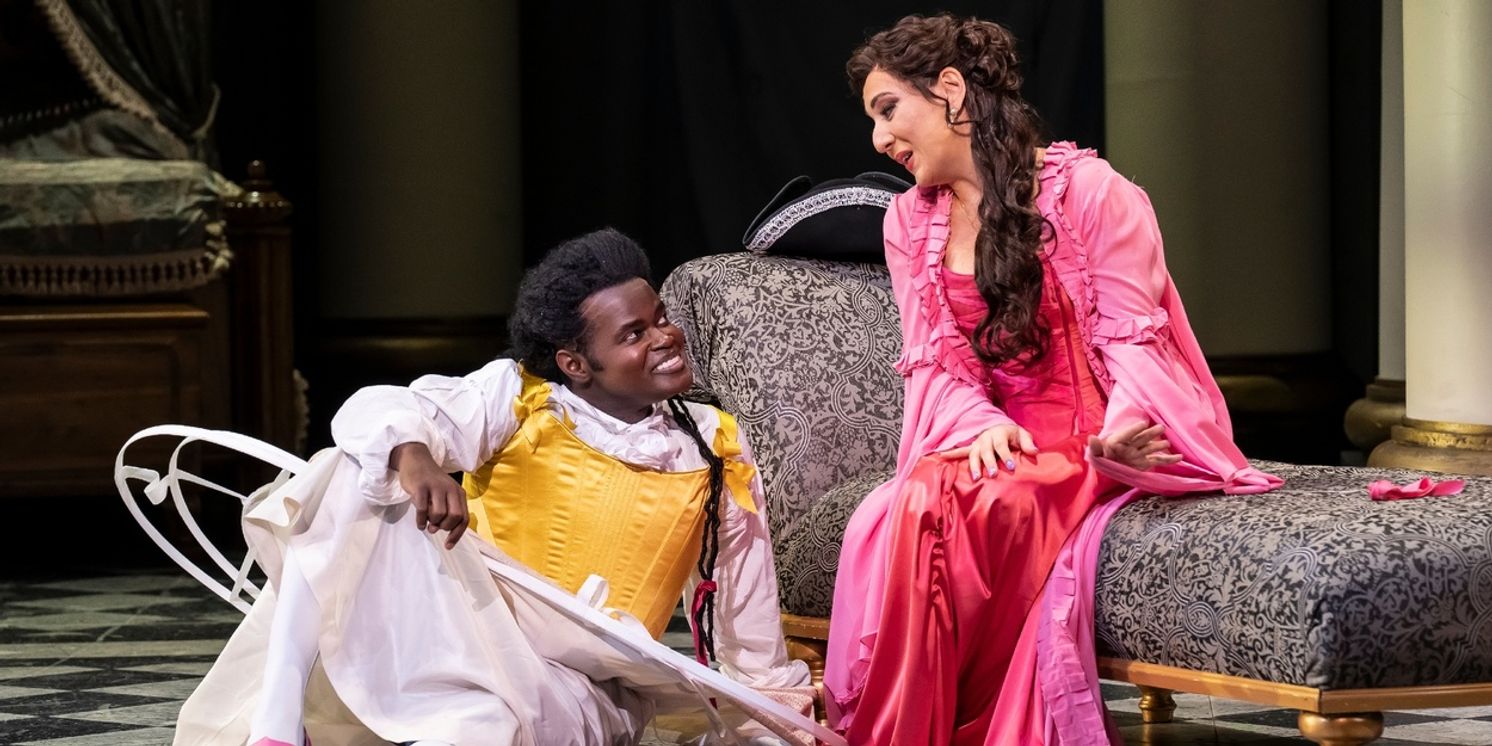
It was notable that the pageboy Cherubini, often played by a female mezzo soprano because of the higher range required, was instead portrayed by standout American countertenor John Holiday, whose voice was up there all night.
Still, he was an odd Cherubini, since he’s older than the singer playing the Count, and taller than him as well — even though there are lines in the libretto about how diminutive he is supposed to be.
Oh well, it’s all light hearted enough to let it pass, on a stage that’s deceptively simple, with its columns dominating the spaces that are divided in scenes with curtain-painted doors to anterooms and closets giving way to a more spacious room. The set is by Benoit Dugardyn, subtly lit by Peter W. Mitchell (after Mark McCullough in the original) to shift from dusk to night. Not so subtle: the spying trees on wheels by the show’s end.
Director Peter Kazaras heightens the fun by allowing actors to add sidelong looks or quick physical comedy takes not always noted in the libretto, retaining a high-spirited feel that's appreciated amid the encroaching darkness beyond the storied theater’s doors. But pack a snack; this is a long one.
Running time: Three hours and 15 minutes, with one 25-minute intermission.
Photo credit: Scott Suchman.
Washington National Opera’s “The Marriage of Figaro,” in Italian with projected English titles, continues through Nov. 22 at The John F. Kennedy Center for the Performing Arts, 2700 F St. NW. Tickets available at 202-467-4600 or online.
Reader Reviews
Videos