


Review: Strauss’s ARABELLA Has the Music and the Singers—and Old Vienna—at the Met
Willis-Sorensen and Konieczny Head Cast of Classic Production under Maestro Carter
By: Richard Sasanow Nov. 12, 2025
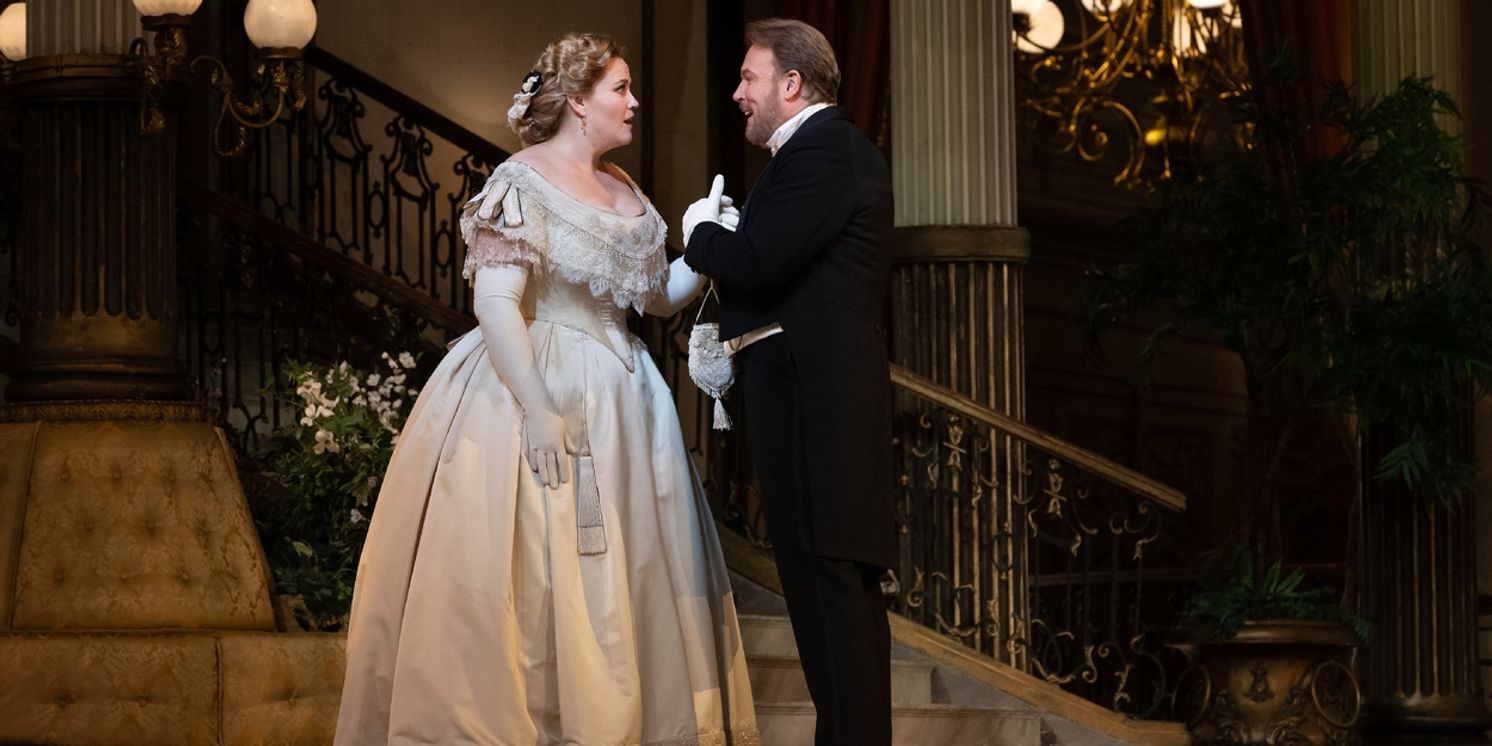
After such notable works as ELEKTRA, DER ROSENKAVALIER, ARIADNE AUF NAXOS and DIE FRAU OHNE SCHATTEN, et al., ARABELLA, currently being revived in style at the Met, was the last of the collaborations of composer Richard Strauss and librettist Hugo von Hofmannsthal…kind of.
Kind of? Well, the wordsmith only finished writing the first act of the opera before he died of a stroke while preparing for the funeral of his eldest son. Strauss completed the rest of the libretto himself, in a manner to be faithful to the work of his longtime friend and colleague.
What he should have done was find a dramaturg who could have helped him shape the work into a piece of a kind that von Hofmannsthal might have helped him produce. According to the librettist’s obituary in The New York Times of July 15, 1929, he had “skill in simplifying the expression of complicated moods, the rhythm and descriptive [that] …struck his admirers as decidedly new and original.
If he was anything like the modern breed of librettists, von Hofmannsthal likely did much more, including helping the composer know when enough was enough, where something moved the story forward and where the libretto was doing something that the composer should have taken the lead on. From my vantage point, Strauss missed that when his frequent collaborator was no longer there.
Despite a gorgeous, romantic score—delivered ravishingly by soprano Rachel Willis-Sorensen and bass-baritone Tomasz Konieczny, and an all-around stellar cast—the libretto finished by the composer needed the help of someone with a good pair of scissors. What he produced was a good 2 ½-hour work that, unfortunately, lasts nearly four hours (including two intermissions) in its current iteration.
Of course, you can’t underestimate the amount that the interpreters of the music bring to the party, starting with conductor Nicholas Carter and the ever-ready Met Orchestra. As the title character, Willis-Sorensen brought a smart sensibility and a rich sound to her music—totally believable as someone who wasn’t going to let herself be married off casually, just to save the family’s finances, no matter how much she loved them. She has a major voice—a big sound—and knows how to use it to express a variety of emotions.
She was vocally well-paired with Konieczny, who didn’t go overboard in shaping the less sophisticated (though much richer) half of the couple, Mandryka. You could almost (almost) believe that he was so fully taken in by the missverstandnis (misunderstanding) that gobbled up so much of the air in the later part of the opera. He had the stamina for the demanding role, without giving up any of the natural appeal of his instrument. You may not have totally bought that Arabella so immediately fell into his thrall, but, well, one can’t always understand the dynamics of attraction.
The rest of the cast—with numerous juicy roles—was good company for the lovers. As Arabella’s sister Zdenka—who has to dress as a boy because the parents can’t afford to “bring out” two daughters in the proper Viennese style, soprano Louise Alder was a charmer, with a substantial, appealing sound of her own, in her Met debut. Mezzo Karen Cargill and bass Brindley Sherratt were a fine couple as Arabella’s parents, singing and acting smartly: her father happy with his card games while mother seemed to still want a bit more out of life than to be a “poker widow.”
Arabella is being sought after by not one but numerous suitors, each of them a match that her parents could have approved of: tenor Pavol Breslik (Matteo) was charmingly frustrated as the obsessive follower of the debutante who is devastated when she announces that Mandryka is the man of her dreams. (As part of the missverstandnis that could have been the subtitle of the opera, he ends up just fine, when Zdenka “comes out” as the girl disguised as a boy, and is happy to be a partner for Matteo.)
The string of suitors was rounded off by debut artist Evan LeRoy Johnson, also a tenor, as Count Elemer, and a strong contender for her Arabella’s affections until he, too, gets his walking papers; and baritone Ricardo Jose Rivera and bass-baritone Ben Brady, both making debuts, as two more in the appealing ensemble of men with their eyes on the impoverished yet appealing title character.
Two more singers of note: soprano Julie Roset, another debutante, in the high-flying role of the party girl at the ball, Fiakermilli and the ever-reliable, resonant mezzo Eve Gigliotti as the fortuneteller who, in Act I, foresees something exciting in Arabella’s future. (Gigliotti is one of those very good singers who bears truth to the old saw “there are no small parts, only small players.”)
For all those operagoers tired of classics set in rodeos, Las Vegas or on a space station (Paris has a BOHEME of that ilk), Otto Schenk’s production for ARABELLA, with stage design by Gunther Schneider Siemssen, dating back to 1983, will be a relief. It features a return to “old Vienna,” including an Act II ballroom scene that’s as welcoming as a sacher torte. Unfortunately, the setting helps point out the shortcomings of the opera itself, making it look even more old-fashioned than it is.
I’ve made no mystery of my preference for the Strauss of SALOME and ELEKTRA versus that of ROSENKAVALIER, which ARABELLA resembles in many ways: a domestic comedy-drama, that lusciously lays out a story that is “much ado about nothing” in my book. The program describes it an “elegant comedy” that “tells the story of an impoverished noble family trying to function on a tight budget in a changing world.”
No matter how superior Strauss was as a composer—and the score has a mind-blowing amount of music that you might relish hearing in an orchestral concert—it can’t, for me, disguise many of the most trite aspects of the story. It’s “a simple romance with a mundane domestic setting,” says the program, “though its characters’ journeys are … moving and affecting.” I can’t argue with either of those statements.
In short, if you like DER ROSENKAVALIER, then ARABELLA is for you.
Caption: Rachel Willis-Sørensen and Tomasz Konieczny.
Photo credit: Marty Sohl/Met Opera
Performances of ARABELLA will continue through November 29. For more information and tickets, see the Met’s website.
Reader Reviews
Videos