


Review: TIRI TE ARAROA - WOMAN FAR WALKING” at ASB WATERFRONT THEATRE
Now on stage through Nov 23
By: Glenda Pearce Nov. 07, 2025
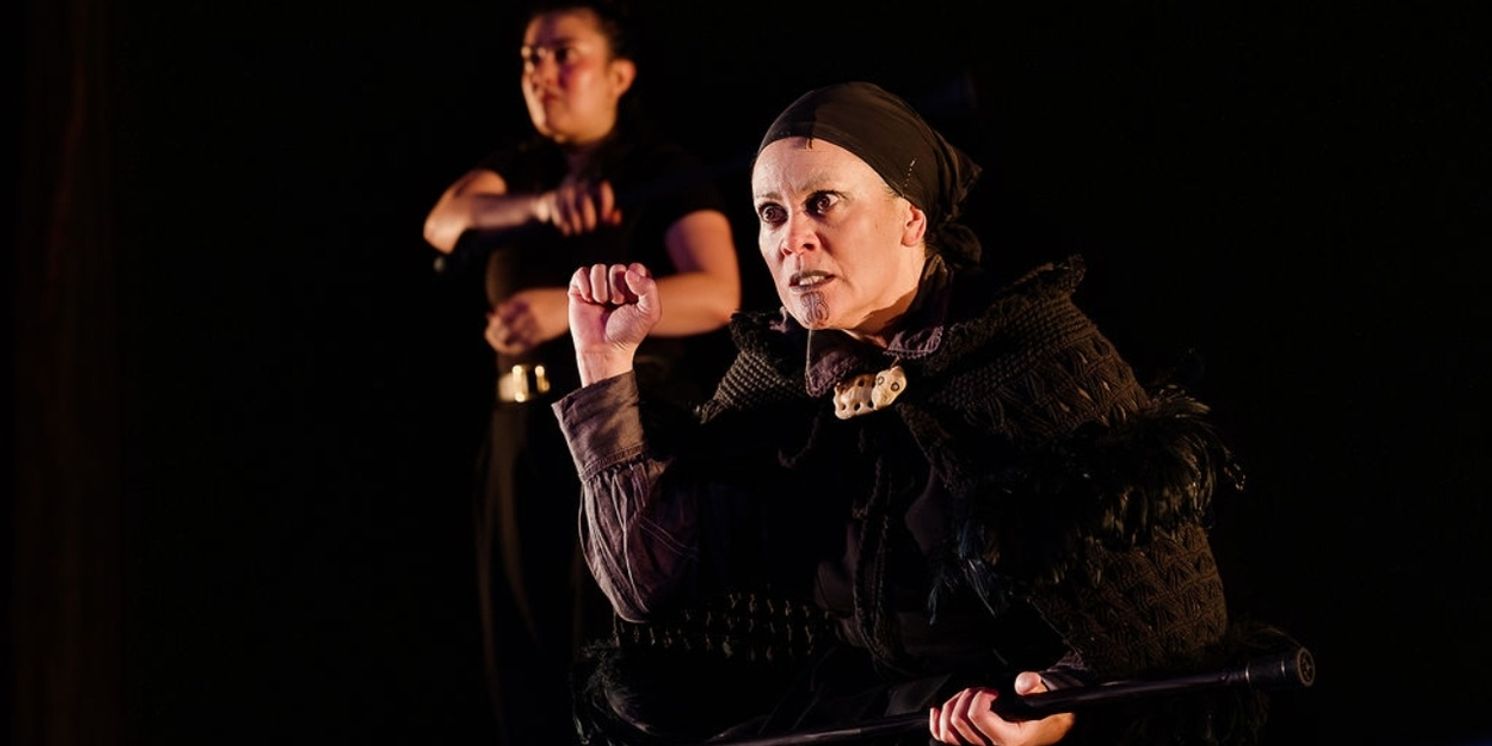
“The tide of time recedes when the moon wanes, sucking at the surf, but my memory is still with those who have gone.”
The lighting is celestial and timeless, creating an atmosphere that feels almost otherworldly. As spellbinding music fills the space, the audience is drawn into silence, captivated by the entrance of the ancient kuia, Tiri. She slowly makes her way through the doorway, leaning on two walking sticks, wrapped in a dark feathered cloak (kahu huruhuru) that resembles a shroud of shadows. This cloak is heavy, and Tiri's bent figure carries it as a burden of grief. Though it takes several minutes for her to reach the audience, we are already captivated, eager to hear her story—a story delivered in the rich tradition of oral Maori storytelling. Through this, the audience is invited to walk in the footsteps of the ancestors and relive a story breathed with rich resonance, and embellished with cultural identity.
This is Witi Ihimarera’s classic play rewritten, unashamedly and boldly from a Maori lens, exploring the often forgotten impacts of colonialism from the signing of the Treaty to the present day. This is history as we think we know it, but don't know it because we haven't felt it. But now we do – with the crafting of “objective history” into a bilingual authentic journey as experienced by the women, especially one woman, Tiriti-o-Waitangi Mahana, named for the Treaty as she was born the day of the signing in 1840.
Ihimaera has said himself, that he is like a carver, inking words on a page to bring tradition to life. Delivered in a Brechtian style, breaking the fourth wall, this is vividly expressed through TIRI (portrayed by Miriama McDowell - Ngāti Hine, Ngāpuhi), whose words guide the audience through poetic metaphors, political statements, resilience, pathos, love, loss, and grief. Her pain is tangible; she has outlived children, grandchildren, and two husbands. With every glance, McDowellcaptures the nuances of a complex and resilient woman, occasionally infusing moments of playful mischief. Her stage presence, honed by screen experience, allows for intimate close-ups that reveal the depth of the character’s heart. Her pain is vivid and real. We can feel it. The role is demanding and multifaceted, and McDowell’s performance embodies both the wisdom and playfulness of Tiri, who, despite her age, retains a youthful spirit.
She’s a woman who began her life “when the Māori ruled this land” but who has outlived her taitamaiti, her mokopuna, two husbands. She has so much to share with us, and some things she’s rather not remember “Too many suns, too many mornings”. Miriama McDowell captures every nuance of this complex, resilient woman, with glances of playful mischief at times. McDowell’s screen expertise is clear with her ability to use close up on stage. Through those eyes alone, we know we are sharing the words of her heart. This is a complex and challenging role, perfectly executed. Miriama Mc Dowell brings her philosophy of playfulness to this role. Even someone who is 185 she says might look younger than her age. Not a day over 150.
In the play, her descendant Tilly (Nī Dekkers-Reihana - Ngāpuhi, Te Rarawa, Ngāti Porou), ) as Tilly, supports Tiri as she re-imagines key moments in her version of New Zealand history, such as the Ngatapa killings, the various wars with the loss of whanau, the 1918 Spanish flu epidemic, the 1981 Springbok tour, the Pukekohe land, Kiri Te Kanawa singing at Prince Charles wedding to Princess Diana, Dame Whina Cooper and the Land March, the meeting of Queen Elizabeth at the Treaty Grounds . The play highlights harsh injustices and inequalities, allowing the audience to understand the anger that has shaped these experiences.
Ni Dekkers- Reihana, flawlessly embodies the personal story - the younger Tiri, as a young child drawing water and building fires for the grandparents she was sent to help, as a young woman with her lustful joy of life with her first husband, the second husband Tainui, married for his laughter, and Tiri’s sons, her brothers, her grandsons, soldiers, public figures – every single speech spoken with truth and conviction. Deeply emotional waiata hold the audience in emotional grip, amplifying the play’s powerful themes of love, loss, and resilience. They intensify the audience’s immersion in the story, evoking a shared sense of palpable grief and hope.
The structure of the play is almost operatic, with the recurring traditional forms of haka and traditional chants. These are powerful devices that strengthen and intensify and the story moves from darkness to something of light and power in the final haka, where TIRI throws away her sticks and stands at full height, emboldened and strengthend by her passion and determination.
This year, Auckland Theatre Company (ATC) has produced so many not to be missed shows. Every New Zealander should see this play, as it challenges audiences to reflect on what they believed was accurate NZ history. An inspired creative team is led by “fearless path forging” director Katie Wolfe (Ngāti Mutunga, Ngāti Tama), with striking set design by John Verryt, imaginative lighting design by Jane Hakaraia, costume design by Te Ura Taripo-Hoskins, enriching composition and sound design from Kingsley Spargo, movement director Katrina George (this is truly outstanding from the two actors), and vision designer Owen Iosefa MacCarthy.
This is a respectful, and transparent lens into the world of Aotearoa, as experienced by the Māori wahine. It is challenging and perhaps confronting for some, but it has a truth and a passion which cannot, and should not, be ignored.
Reader Reviews
Videos