
Review: A STREETCAR NAMED DESIRE at Opera Theatre Of St. Louis
Challenger Blanche DuBois vs. Stanley Kowalski! A musical rematch!
Opera Theatre of St. Louis does luscious justice to A Streetcar Named Desire—André Previn’s operatic adaptation of the Tennessee Williams classic.
Williams’ play was a smash hit on Broadway in 1947, and Blanche DuBois and Stanley Kowalski became instant American icons. These two are Williams’ most strikingly memorable characters, representing as they do the epitomized masculine and feminine—elemental forces which perpetually struggled within the psyche of the playwright himself, and which, in this play, engage in mortal combat.
The play is set in a steamy summer in New Orleans’ French Quarter, which Williams loved so well. We see Blanche in dire need seeking shelter at her sister Stella’s working-class home.
She’s in utter financial and emotional distress and there’s not a moment when she can forget that. She’s continually taking warm baths “for her nerves”, but she can no more wash away her remembered shame than can Lady Macbeth wash away her guilt.
The emotional catastrophe of her young husband’s suicide left her with an enormous burden of guilt and a profoundly damaged sexual confidence. The rest of her life has been a desperate effort to escape the one and restore the other.
Ever since A Streetcar Named Desire opened in 1947 people have called for it to be made into an opera. Indeed at its very heart it is operatic. Those floridly poetic passages that some called “purple patches” others called “arias”. And Williams himself made music an important element in the play; there are more than thirty music cues in the script—wisps of jazz, popular songs, a rhumba, a recurring elegant polka, honky-tonk and (almost pervasively from a bar ‘round the corner) what Williams calls a “blue piano”.
Over the years there have been three different ballet versions of Streetcar; Williams’ Summer and Smoke became an opera in 1971; but it was not until 1995 that André Previn was given a commission to compose an opera based on Streetcar.
Previn’s amazing career delved into every corner of serious music, from jazz to classical to art songs as well his many award-winning film scores. The score for Streetcar is rich and modern and very like the best film score you ever heard. It beautifully supports not only the turbulent emotions in the drama, but often movements and even gestures; it is, if you will, programmatic in a very detailed way. We hear urgency, lust, panic, tenderness. Sometimes strange and jarring chords involving “stacked keys” (i.e. two conflicting keys at the same time) dramatize the growing conflict and menace at the heart of the play.
Previn’s collaborator, Phillip Littell, takes his libretto for the most part directly from the text of Williams’ play. Hence, most of the opera comes across as syllabic recitative—occasionally rising into arioso. Now Williams’ words are precious indeed, and it is right to preserve them. But, as poetry, they have their own internal music—and perhaps it is unwise—or impossible—to superimpose another, external, music onto them
Blanche, Stella and Mitch all have lyrical arias or ariettas. Only Stanley is without one. But what is an aria? It’s the verbal expression of a character’s inner feelings. Stanley, the iconic male, is not verbally articulate; he expresses himself not with words but with his body, his muscle, his hands. So, alas, though baritone David Adam Moore deserves one, Stanley should really not have an aria.
The score left me hungering for three things:
- Though several times there is some overlapping of voices, there are absolutely no duets or trios. As in Poulenc’s Dialogues of the Carmelites we are mostly stuck with just dialogue. I’m told that the Williams estate specifically forbade the inclusion of any duet or trio. (My god! Lawyers telling a composer how to compose?!) What insanity—to forbid the musical expression of the complex interplay of these hearts?! And surely there’s a quartet just waiting to be revealed under that poker scene.
- An even stronger sense of New Orleans music. We do find some jazzy trumpet and clarinet, the occasional raunchy saxophone, but we want—we need—a still greater embrace of the musical feel of this place.
- I’m so old-fashioned! I yearned for more melody, more tonality. The scenes of timid romance between Blanche and Mitch do provide a welcome breath of melody, but it’s too rare. Streetcar is, after all (in the best sense of the word) melodramatic. And atonality simply does not serve melodrama very well.
Soprano Patricia Racette has, in the past year, stepped gracefully into the role of Artistic Director for the company. Streetcar is her first effort as Stage Director in that new role. In her program note she says she wants the audience:
“to feel the heat, claustrophobia, and emotional compression of Blanche’s world—as though they have a seat inside her psyche as her world tilts, splinters, and ultimately slips beyond her control.”
This production resoundingly accomplishes that goal!
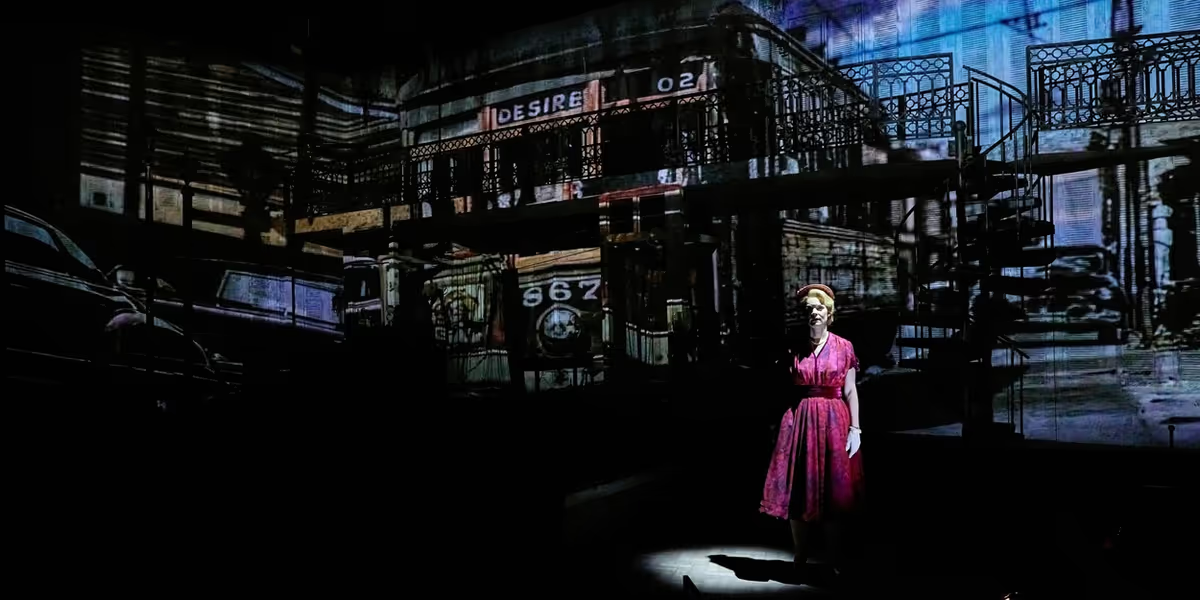
Set designer Andrew Boyce, Projection Designer Kylee Loera, and Lighting Designer Eric Southern present a quite remarkable visual setting for the drama. In my long life I’ve seen several productions of Streetcar the play, and one previous production of this opera, but never have I seen a production whose designers have so carefully studied and so faithfully pursued Tennessee Williams’ actual stage directions. Williams describes a world part reality, part dream and, in the end, part mad nightmare. It is occasionally impressionistic. At times the walls become transparent, fragments of street life in the French Quarter are seen, lurid shadows throb and flow.
At the top of the show we see Blanche arriving at “Elysian Fields”—a row of shabby apartments, upstairs and down, with a wrought-iron balcony. We see the “Desire” streetcar arriving in wonderful projections like a great distorted black-and-white film. Period, place, and mood are stamped into our minds.
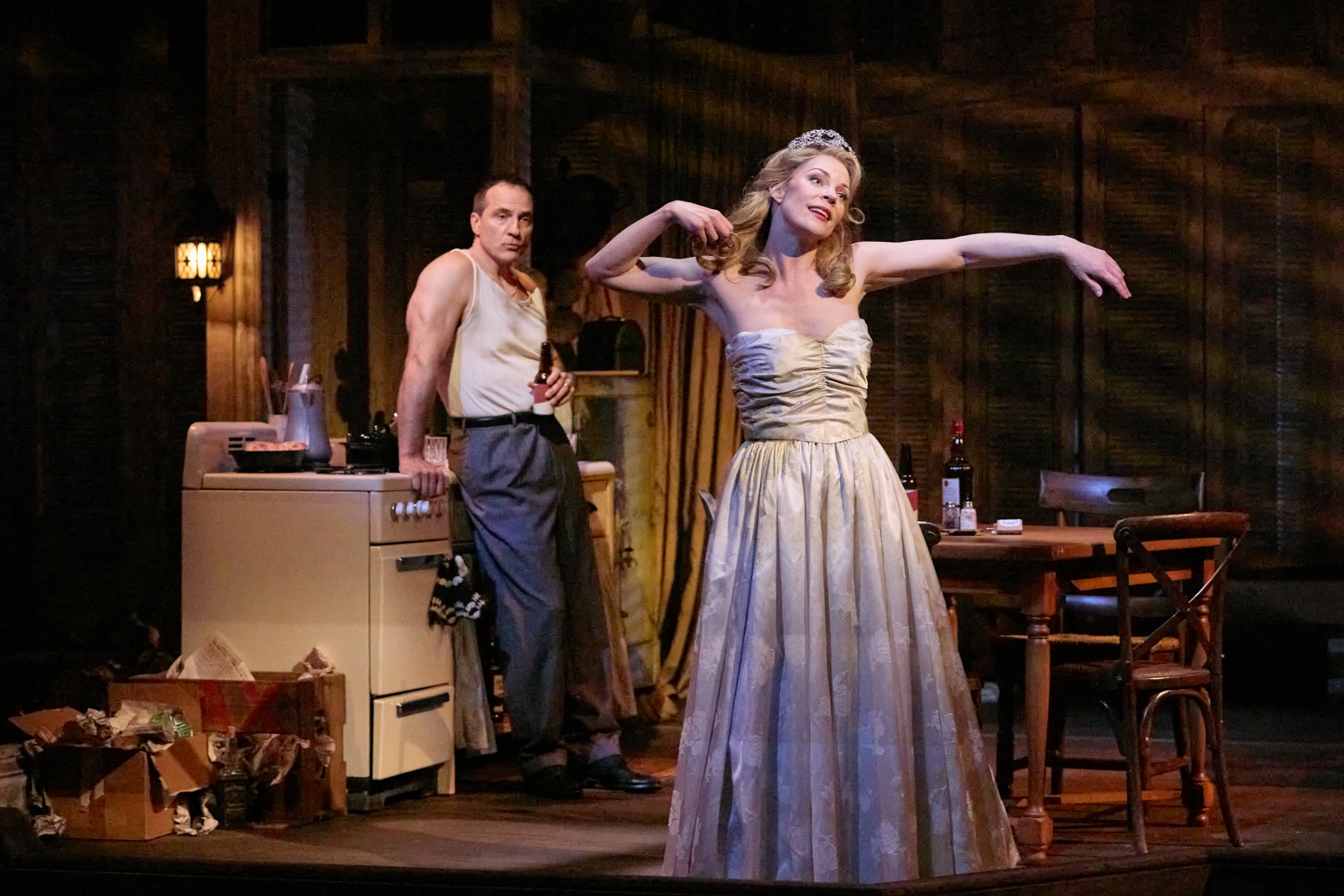
It’s a very strong cast. Soprano Sara Gartland sang that delightful Rosalinde in last year’s Fledermaus. Now she swaps her comedy mask for a tragic one; she’s that lost soul, Blanche DuBois. This is a true tour de force role, and Ms. Gartland triumphs in it. Her voice can soar into such heights—where she finds a pure, crystalline sweetness. Her dramatic range flows readily from prim pretense to drunken rage. In that lovely scene with the innocent young man collecting for the newspaper she makes Blanche relish flexing her waning arts of flirtation.
Stanley Kowalski is sung by baritone David Adam Moore in his debut at OTSL. Moore beautifully merges Stanley’s macho masculinity with his justified gnawing fear that Blanche is trying to rip his marriage apart. It’s a strong performance musically and dramatically.
Stella, Stanley’s wife, is quite perfectly sung by soprano Lauren Snouffer. When she sings, just ignore those supertitles. Her voice is so clear and her diction so fine that we understand her every syllable. And she gives us so many small proofs of her deep and total love for Stanley. After her night of reconciliation with Stanley Stella sings a lovely vocalise arietta. Ms. Snouffer makes it absolutely blissful. She’s a bright highlight of this production.
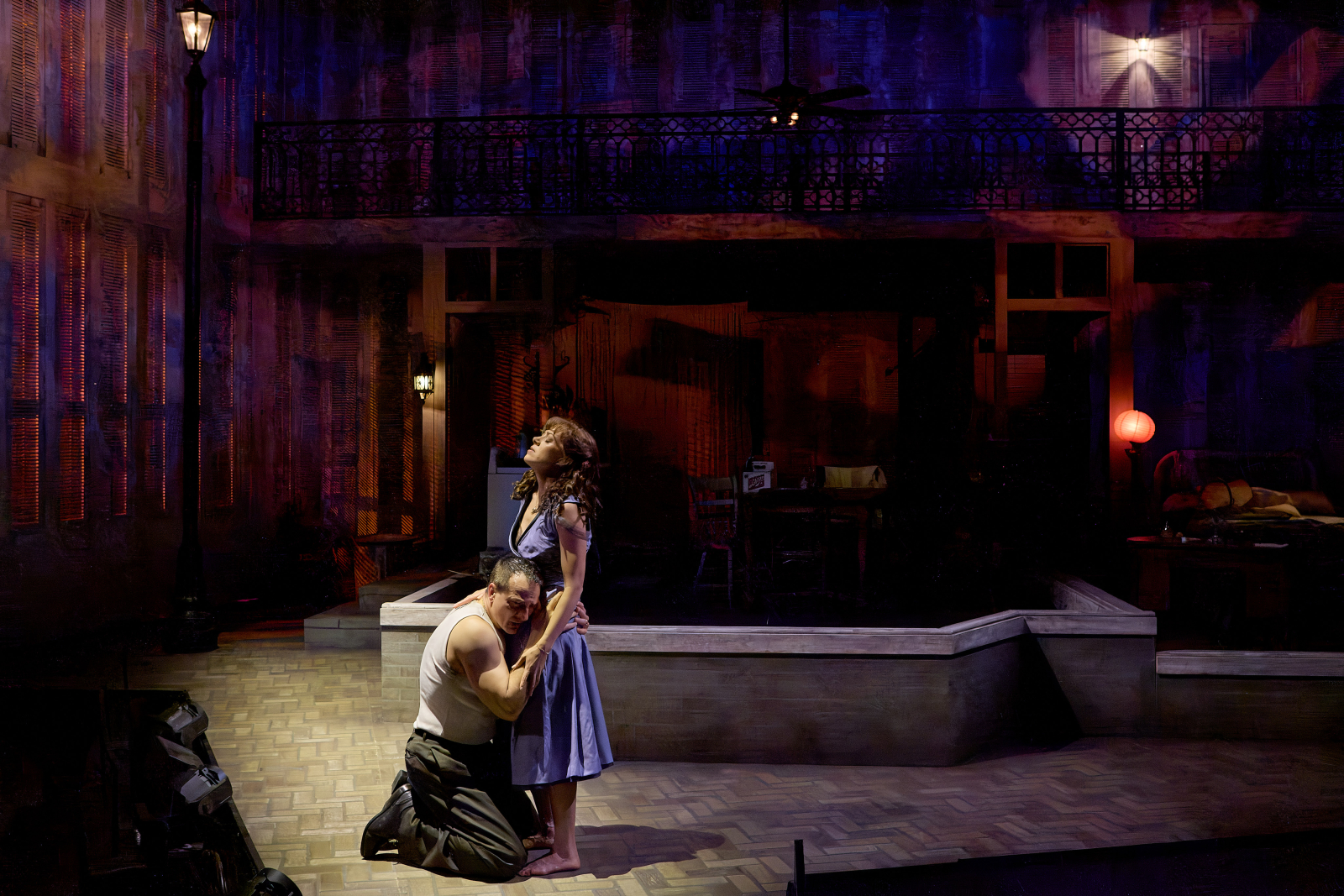
Bille Bruley sings Stanley’s friend, Mitch. Mitch, unmarried and devoted to his his invalid mother, is much gentler than the other buddies at Stanley’s poker table. Bruley captures this man’s awkward innocence as he’s drawn romantically toward Blanche’s tawdry glamor. Previn gives Mitch and Blanche much of the show’s rare melody and lyricism. Bruley and Ms. Gartland find great beauty in that music.
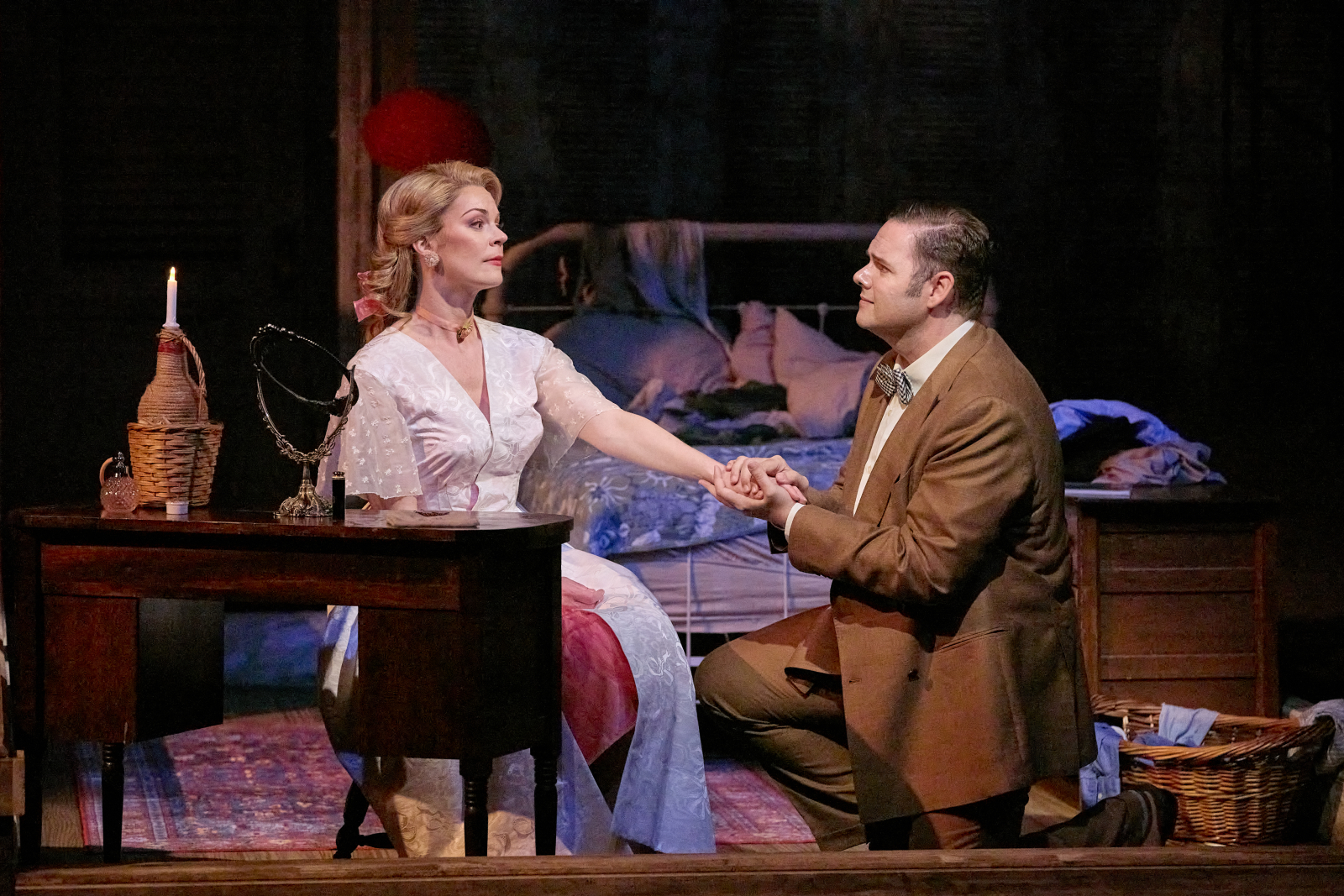
Supporting roles are all strongly played:
- Ashlyn Brown (Stella’s neighbor and faithful friend Eunice)
- Landry Allen and Cole Bellamy (poker buddies Steve and Pablo)
- Edmond Rodriguez (the young collector for the newspaper)
- Erik DeMario (the doctor)
- Kim Stanish (the nurse)
- Rosario Armas (the flower seller who haunts Blanche’s confession to Mitch:
“Flores? Flores para los Muertos?”)
Costume Designer Amanda Gladu fits each character beautifully into this time and place. She lavishes style on Blanche, whose wardrobe properly sets her apart from the others in this story. Perhaps, though, some of these fancy togs should be a bit more faded or wrinkled or sagging—like Blanche herself.
The orchestra, under the direction of the brilliant Daniela Candillari is utterly gorgeous. I am ever-astonished at how these superbly talented musicians grasp the perfect acoustics of this hall and give us such presence, such pure access to the timbre of each instrument, such awareness of subtleties of dynamics. In her program note Ms. Candillari places this Streetcar in the realm of operatic magical realism. She and her team build the perfect foundation for that realm. Bravo!
This nearly perfect production does have two points with which I would argue. Two elements of excess (over and beyond the romantic and poetical excesses for which Tennessee Williams is famous):
- At two dreamish points in the show faces appear, close-up, in the vast projections at the rear—first Blanche’s tragic young husband, and later … is it perhaps the street flower seller? These are huge dramatic faces looking at us, and they totally distract our eyes from poor Blanche who is singing her heart out below in the dim and moving lights.
- Sex is so important in this story. There are two moments where characters engage in sex—one joyous, one violent. When Stanley strikes her, Stella flees to the neighbor upstairs, but his famous soul-rending “Stella! Stell-lahhhhh!” brings her back down. They passionately embrace and (as Williams’ stage direction says) “he lifts her off her feet and bears her into the dark flat.”
‘Nuff said. We know what happens.
Later, Stanley strikes his final blow in his bitter war with Blanche. He is going to rape her. He tells her, “We’ve had this date with each other from the beginning. He lifts her inert figure and carries her to the bed.”
‘Nuff said. We know what happens.
But in this production such a closing is not enough. Here, in both cases, we actually see the (simulated) thrusting between spread thighs. Now I’m a long-time fan of sex, and I know that nowadays “intimacy coordinators” get big bucks for primly and properly choreographing such stuff. But just because we can get away with rather graphic sex on stage doesn’t mean that it furthers the drama. That old quick blackout and the audience’s imagination are almost always more effective. When sex gets really graphic, is it possible, even in these liberated times, for us not to wince a little for the actress’ modesty?
(And Williams has Stanley don his silk P.J.s behind a closed bathroom door. Why, in this production, do we see Stanley, behind a transparent wall, strip to his boxers and put on the pajamas? [And what man, when planning a rape, wears boxers under his pajamas? Perhaps you, dear reader, but certainly not our Stanley.])
But (as is my habit) I rant.
Once again Opera Theatre of St. Louis combines the very best of vocal and musical talents with superb design and technical elements. This production of A Streetcar Named Desire, adapted by André Previn from the Tennessee Williams play, runs through June 26.
(Photos by Eric Woolsey)